Argentina’s Andean Cat, a beautiful wildcat that resides in the Andes mountains, is officially classified as endangered. With less than 1,500 individual Andean cats believed to exist in the wild, it’s critical that we save this species before it’s too late.
What is an Andean Cat?
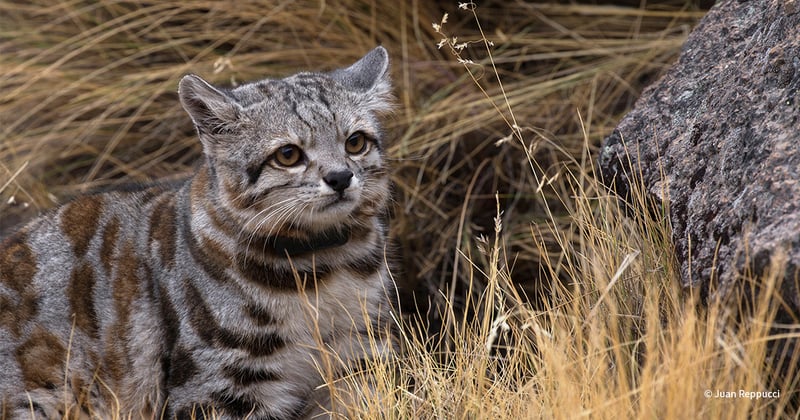
The Andean cat is one of the rarest and least-known cats in the world. They live exclusively in the Andes Mountains and Patagonia steppe, where climates are harsh, and food is scarce.
Despite being formidable predators of birds, rodents, and other small mammals, Andean cats have adorable little black noses and might be mistaken for housecats if not for their larger heads and long, bushy tails. They have rounded ears, dark brown lines beside their eyes, and their fur is covered in dark rings.
The Andean cat can live at elevations up to 13,000 feet. Their main food source is the mountain viscacha, and they do the bulk of their hunting at night.
How is the Andean Cat Threatened?
Sadly, due to human factors such as mining, hunting, and unregulated tourism, the Andean cat population is rapidly decreasing—with estimates of fewer than 2,800 remaining today. With their habitat isolated to the high desert of the Andes, land conservation is critical to the survival of their species.
Why are Andean Cats Important?
These small predators have an essential job in their ecosystem: controlling small prey populations. Their hunting is essential in keeping a well-balanced ecosystem. These wildcats are also very important to local indigenous communities like the Aymara and Quechua, who recognize the animal as a sacred symbol of fertility.
A Rare Sighting, Three Years Running
Some conservation wins arrive quietly, as a handful of frames on a memory card.
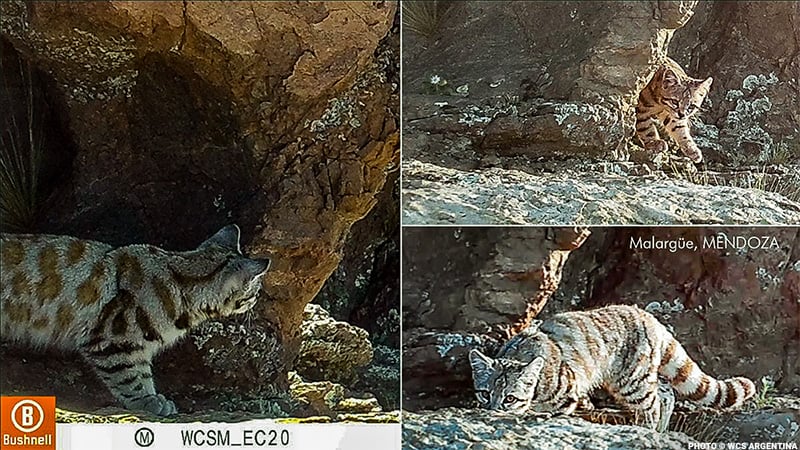
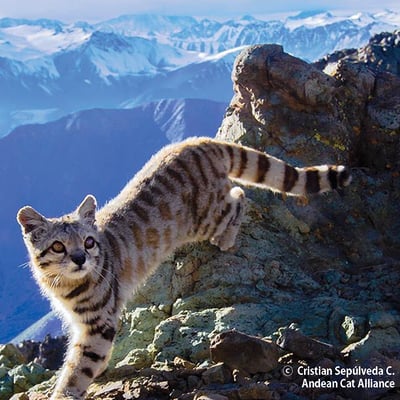
About six miles outside La Payunia Protected Natural Area, a camera trap photographed an Andean cat (above)— the third year running that this stretch of rock has produced a record. For a cat this solitary, a repeat appearance means something a lone photograph would not. It suggests the animal isn't simply passing through; it lives there.
Getting a camera onto the right rock took local knowledge. Ranchers in the area reported sightings for years, eventually pointing our partner, WCS Argentina, toward the site. Dr. María José Bolgeri, the organization's regenerative management manager, credits those testimonies with guiding the search.
The find came out of a much larger effort. Nine camera traps at Lonco Vaca produced over 66,000 images across the season, documenting several species native to the area. The network has since expanded to rock outcrops near the Morado Chico volcano, where students from nearby conservation programs helped install the newest cameras.
How Greater Good Charities is Making a Difference
Thanks to the generous help of our donors, Greater Good Charities, in partnership with GreaterGood.com, has helped the Wildlife Conservation Society acquire over 150,000 acres in the Province of Mendoza for conservation purposes. This high desert region is home to unique wildlife including the Guanaco, Andean Condors, Geoffrey's Cat — and of course the Andean cat.
Those cameras sit on land your support helped protect. Every image they collect — of the animals we expected to find and the ones we didn't — tells us whether that protection is working.
With your help, we can continue to conserve vital land and endangered species like the Andean cat.